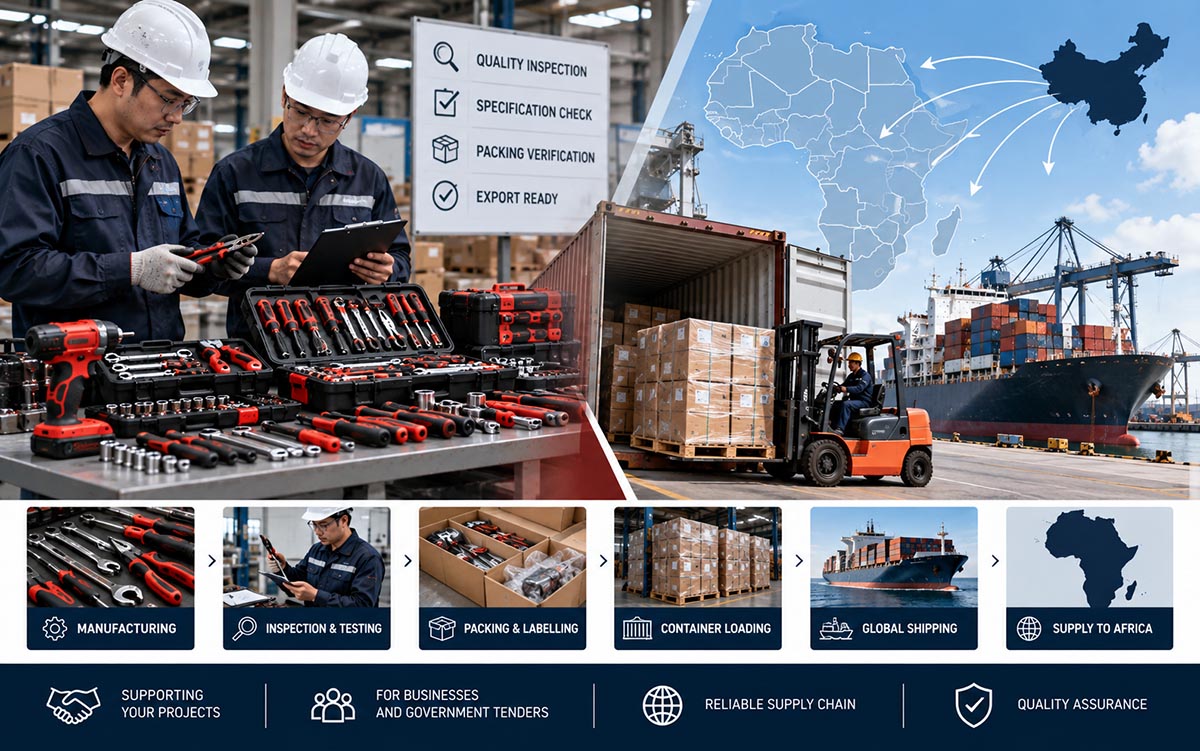
How to Win Hand Tool Tenders in Africa: A Supplier Guide to the Top 10 Markets
Public buyers across Nigeria, Egypt, South Africa, Kenya, Ghana, Tanzania, Ethiopia, Morocco, Algeria and Angola buy tools by tender. Here is how those tenders work, what the documents demand, and the five mistakes that get bids disqualified before price is opened.
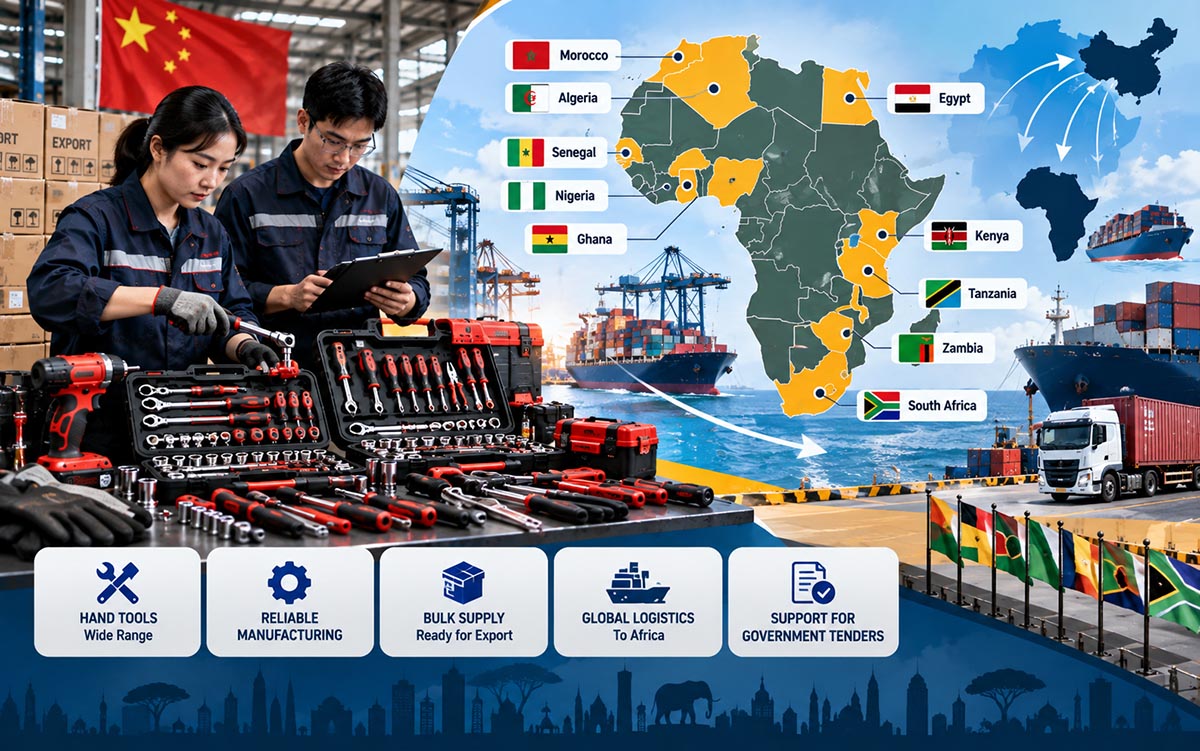
Public buyers in Africa do not shop. They publish a tender, receive sealed bids, score them against a checklist, and disqualify anything that does not match. If you supply tools, that is good news: the scoring is mechanical, so a bid that is technically compliant and properly documented beats a cheaper bid that is not.
This guide covers the ten African markets where we see the most tool tenders, what the documents ask for, and the handful of mistakes that get bids thrown out before price is even opened.
Who buys tools on tender
Tool tenders rarely come from retailers. They come from organisations that maintain things at scale:
- Ministries of Works, Roads and Transport — workshop equipment for road maintenance depots and vehicle fleets.
- Ministries of Agriculture and agricultural development agencies — field tools distributed to farmer cooperatives, often in very large quantities.
- TVET colleges and technical education boards — training tool kits, usually one identical kit per student bench.
- Railways, ports and power utilities — maintenance tools, cutting and welding equipment.
- Armed forces and police logistics branches — vehicle workshop tooling.
- Mining and oil parastatals — abrasives and power tool accessories in consumable volumes.
- Donor-funded projects — World Bank, African Development Bank and EU programmes, which run their own procurement rules on top of the national ones.
The donor-funded category is worth attention. Those tenders are advertised internationally, the rules are published, and the evaluation is usually stricter and more predictable than purely domestic procurement.
The ten markets and where tenders appear
Every country runs a central procurement authority and, increasingly, an electronic portal. Registration is normally free but takes time, and in several markets a foreign bidder must either register locally or bid through a local agent.
| Market | Procurement authority | Notes for foreign suppliers |
|---|---|---|
| Nigeria | Bureau of Public Procurement | Large federal and state-level volumes. Local agent normally required. |
| Egypt | Central procurement under the public tenders law | Arabic documentation. Local representation expected. |
| South Africa | National Treasury eTenders, Central Supplier Database | Supplier must be registered on the CSD before award. |
| Kenya | Public Procurement Regulatory Authority | Portal-based. Strong preference rules for local content. |
| Ghana | Public Procurement Authority, electronic procurement system | Well-documented process, frequent TVET tool tenders. |
| Tanzania | Public Procurement Regulatory Authority, national e-procurement system | Registration on the portal is mandatory to download documents. |
| Ethiopia | Public Procurement and Property Disposal Service | Letter-of-credit based. Allow for foreign exchange delays. |
| Morocco | National public procurement portal | French-language documents. Electronic submission is standard. |
| Algeria | Public procurement code, ministry-level publication | French and Arabic. Import formalities are demanding. |
| Angola | Public contracting portal under the Ministry of Finance | Portuguese-language documents. |
Portals, URLs and registration requirements change. Confirm the current process with the authority itself, or with your local agent, before you rely on any of it.
What a tool tender document actually contains
Open almost any tool tender and you will find the same six parts.
1. The Bill of Quantities
A numbered schedule of every line, with quantity and unit. This is the heart of the bid. Price each line separately; a lump sum for a group of lines is a common reason for rejection.
2. Technical specifications
Dimensions, material grade, finish, hardness, and often a named standard such as DIN, ANSI or ISO. Where a brand is named, the document will usually add “or equivalent”. Equivalence has to be proven, not asserted — see the next section.
3. Bid security
A bank guarantee or bid bond, typically 1–2% of the bid value, valid for the full bid validity period. An expired or wrongly worded guarantee disqualifies the bid regardless of price.
4. Delivery schedule and place
Often a named store, sometimes several across the country. Inland distribution can be a significant cost that bidders forget to include.
5. Qualification criteria
Years in business, similar contracts completed, annual turnover, and manufacturing capability. This is where a manufacturer-backed bid is stronger than a trader-backed one.
6. Warranty and after-sales
Twelve months is the usual minimum for hand tools, longer for machines. Some tenders require a spare-parts commitment for several years.
Proving “or equivalent”
Most disqualifications we see come from this clause. The tender names a brand and specification; you offer something comparable; the evaluation committee has no basis on which to agree, so they reject it.
What actually works is a technical comparison table submitted with the bid: the tender requirement in one column, your offered specification in the next, and the evidence in the third — a material certificate, a test report, a dimensional drawing. Committees accept equivalence when it is demonstrated line by line. They almost never accept it when it is claimed in a sentence.
The documents that decide compliance
- Manufacturer’s Authorisation Form. Where the bidder is not the manufacturer, most tenders require a signed letter from the factory authorising that bidder for that specific tender, usually naming the tender number. This is issued per tender, not once.
- Certificate of incorporation and tax clearance for the bidding entity.
- Audited accounts for the number of years stated.
- Reference contracts with contact details that will be called.
- Samples. Increasingly common for hand tools. Read the deadline carefully — samples often have to arrive before the bid closes, which means shipping weeks in advance.
Pricing the bid
Quote on the Incoterm the tender asks for, not the one you prefer. Tool tenders in these markets are usually CIF to a named port, or DDP to a named store. If the tender says DDP and you quote FOB, your price looks lower and your bid is non-responsive.
Build the price from: ex-works cost, export packing, inland haulage to the Chinese port, sea freight, marine insurance, destination clearance, duty and VAT, inland distribution, plus the cost of the bid bond and performance guarantee. Duty on hand tools varies widely across these ten markets, and several operate additional levies on top of the published rate.
The five most common reasons tool bids fail
- Bid security wrong in value, validity or wording.
- Bill of Quantities priced in the wrong format, or lines left blank.
- Equivalence claimed but not evidenced.
- Manufacturer’s Authorisation missing, generic, or not naming the tender.
- Delivery period quoted longer than the tender allows.
None of these is about price. All five are avoidable.
How we support tender bids
We manufacture in China and supply on a bulk and tender basis only, which means the paperwork a committee wants is paperwork we can actually issue: manufacturer’s authorisation naming your tender, technical data sheets per line item, material and test certificates, and a production and shipping plan matched to the delivery period in the document.
Send us the Bill of Quantities and the closing date. We price it line by line and return the technical comparison table with it. Browse the full catalogue or go straight to hand tools, workshop hand tools, power tools, welding machines and tools, power cutters and agriculture tools.
Send us a tender schedule and we will quote it.
Need these tools in container quantities?
We manufacture in China and supply bulk orders and tender contracts. Send a product list or a tender schedule and we price it line by line.
Request a quote