Conformity, Inspection and Shipping for Tool Tenders to Africa
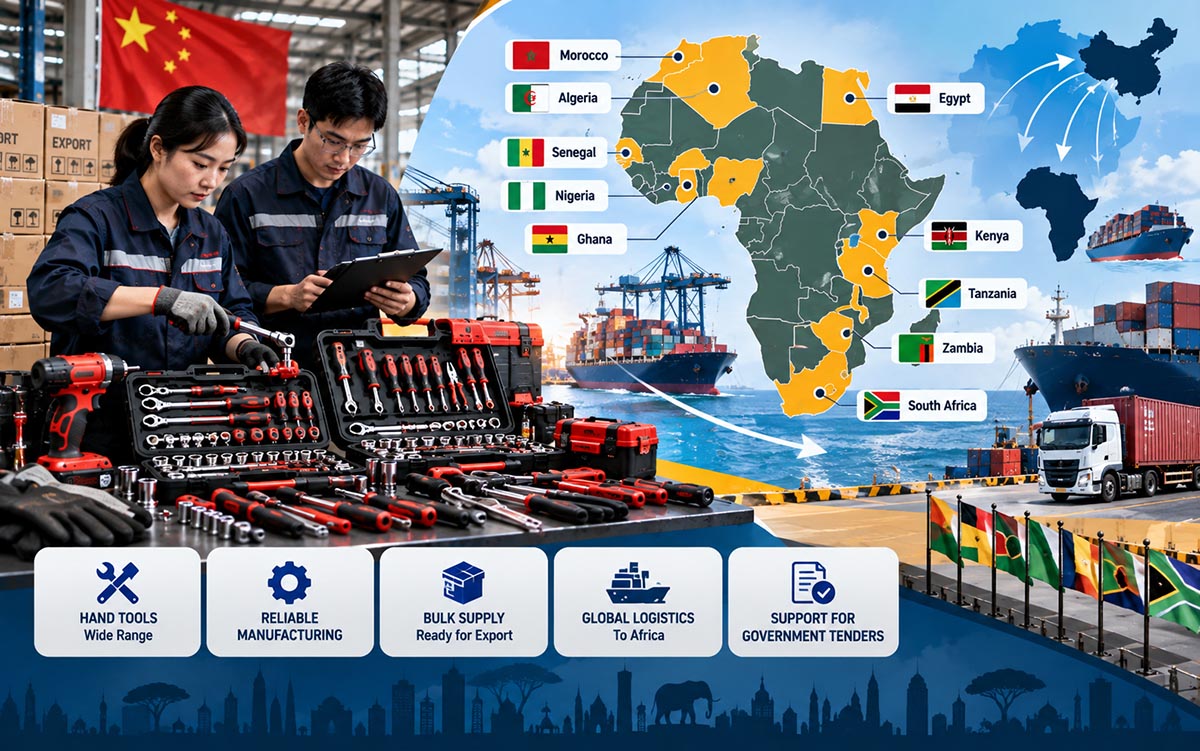
Pre-shipment conformity certification, inspection stages, realistic transit times and the packing and marking a tender delivery needs, across the ten African markets where we ship most tool contracts.
A tool tender is won on paper and lost at the port. The technical bid can be perfect and the price competitive, and the contract can still go wrong because a conformity certificate was applied for after shipment instead of before it.
This is the compliance and logistics side of supplying tools into the ten African markets where we see the most tender activity: what has to be certified, who inspects it, how long shipping actually takes, and how a tender delivery should be packed and marked.
Pre-shipment conformity: the part that catches people out
Several of these markets operate a pre-shipment conformity assessment programme. The principle is the same everywhere it applies: goods are inspected, tested or documented in the country of export, a certificate is issued before the vessel sails, and without that certificate the consignment cannot be cleared at destination.
The mistake is treating this as destination paperwork. It is origin paperwork. Once the container has sailed, the options are a penalty, a destination inspection at much higher cost, or re-export.
| Market | What typically applies to tools |
|---|---|
| Nigeria | SONCAP certification through the Standards Organisation of Nigeria, alongside Form M and the customs valuation report. |
| Kenya | Pre-Export Verification of Conformity administered for the Kenya Bureau of Standards, with an import declaration form. |
| Tanzania | Pre-export verification for the Tanzania Bureau of Standards. |
| Ghana | Conformity assessment under the Ghana Standards Authority. |
| Egypt | Exporter and factory registration requirements for certain product groups, plus inspection on arrival. |
| Algeria | Import documentation and bank domiciliation requirements that must be completed before shipment. |
| Ethiopia | Letter-of-credit based imports with standards authority involvement. |
| Morocco | Conformity certification for regulated product categories. |
| South Africa | Regulatory approval for electrical products through the national regulator, in addition to standards compliance. |
| Angola | Pre-shipment inspection and import licensing. |
These programmes are revised regularly, and which product codes fall inside them changes with them. Always confirm the current requirement against the tariff code of the specific goods, with the destination authority or your clearing agent, before production is booked. Do not rely on what applied last year, and do not rely on this table alone.
Electrical goods need more than a conformity certificate
Power tools, welding machines and electric cutters carry an extra layer. Beyond conformity assessment, several markets require a product-specific electrical approval, and all of them require the equipment to match the local supply.
- Voltage and frequency matched to the destination.
- The correct plug, fitted — not supplied as an adaptor.
- Safety marking on the rating plate, permanently fixed.
- A manual in the working language, which some tenders make a condition of acceptance.
Get this wrong and the goods clear customs, reach the store, and are rejected on inspection — the most expensive failure mode of all. See power tools and welding machines and tools.
Inspection before the container is sealed
Most public tenders of any size give the buyer the right to inspect before shipment. Use it, and encourage the buyer to use it, because it protects both sides.
Three levels are normal:
- Reference sample approval before production. Essential for agriculture tools, where regional pattern preferences cannot be captured in words. See agriculture tools.
- During production inspection at roughly 20–50% completion, so a systemic fault is caught while it can still be corrected.
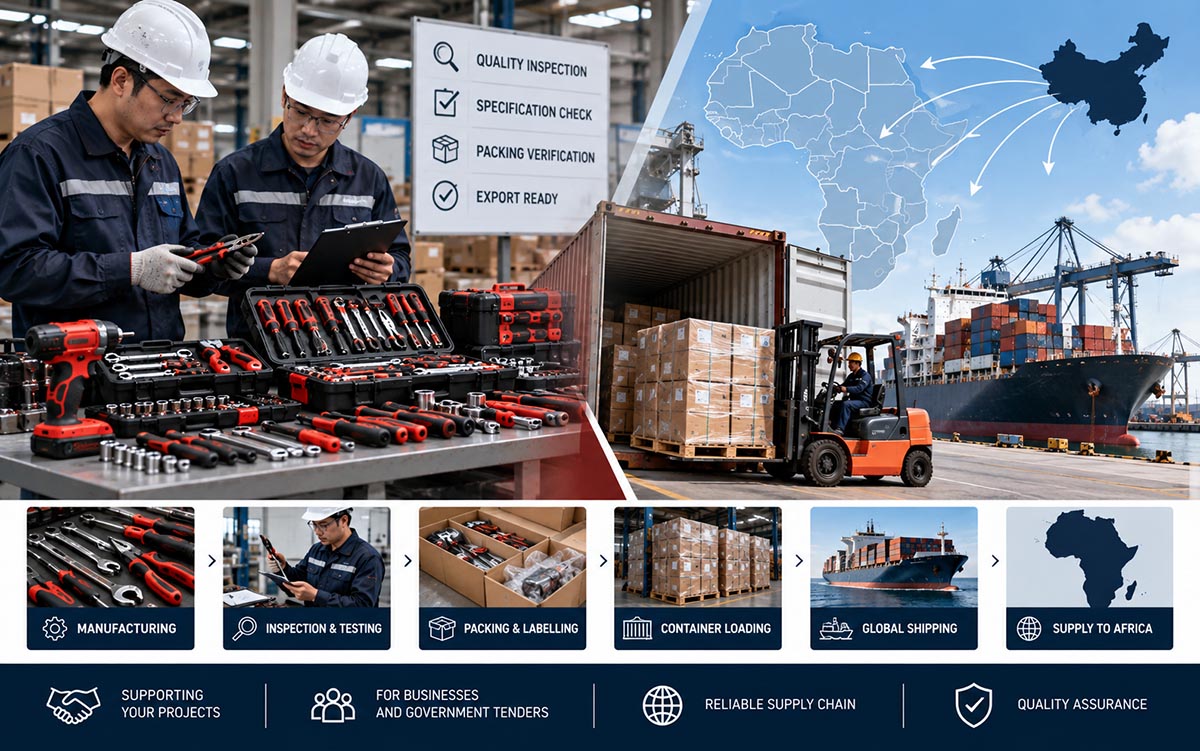
- Pre-shipment inspection against a sampling plan, covering dimensions, hardness, finish, marking, function and packing.
Buyers may nominate their own inspector or appoint an independent agency. We work with either. Where the tender names an inspection body, factor its lead time into the delivery schedule — booking an inspection is not instant.
Realistic delivery timelines
Tender delivery periods are often written by someone who has not shipped from Asia. Build the schedule backwards from the contractual delivery date:
- Artwork and sample approval: 7–14 days.
- Production: 25–40 days for custom or branded items; stock lines ship in 7–10.
- Inspection and conformity certification: 7–14 days, and it cannot start before production finishes.
- Booking and sailing: allow a week between cargo ready and vessel departure.
- Sea transit from China: roughly 20–30 days to East African ports, 25–35 to West Africa, 30–40 to South Africa, 18–28 to North African ports via Suez.
- Destination clearance: a week where paperwork is clean, considerably longer where it is not.
- Inland haulage to the named store.
Landlocked destinations add substantially. Cargo for Ethiopia routes through Djibouti; other landlocked deliveries route through Mombasa, Dar es Salaam, Tema or Durban with a corridor haul beyond. That corridor leg is frequently the least predictable part of the whole chain.
Packing and marking for a tender delivery
Tender goods are received by a store keeper with a delivery note, not by a buyer who knows the order. Packing has to make verification possible.
- One Bill of Quantities line per carton type wherever possible. Mixed cartons make counting slow and disputes likely.
- Carton marking showing the tender or contract number, line item number, description, quantity, net and gross weight, and carton number in a running series.
- Packing list per carton, plus a master list matching the Bill of Quantities line for line.
- Moisture protection. Coastal storage and long corridor hauls are hard on unprotected steel. Specify VCI paper or oiled wrap for bright-finished tools.
- Palletisation where the store has handling equipment, loose loading where it does not. Ask, rather than assume.
- Distribution packing for agriculture programmes: bundles sized for onward district-level distribution rather than for container efficiency.
See hand tools, workshop hand tools and power cutters for the ranges we ship in tender quantities.
The document set that travels with the shipment
- Commercial invoice, matching the contract values exactly.
- Packing list, matching the Bill of Quantities line numbering.
- Bill of lading.
- Certificate of origin.
- Conformity certificate, where the destination requires one.
- Inspection report, where inspection was contractual.
- Insurance certificate for CIF and DDP terms.
- Warranty certificate and manuals.
Values, descriptions and quantities must agree across all of them. A discrepancy between the invoice and the packing list is one of the most common causes of clearance delay, and it is entirely avoidable.
Working with us on a tender
We manufacture in China and supply bulk and tender contracts only. That means production, inspection scheduling, conformity documentation and the shipping document set are handled by one company, against one delivery plan — not coordinated across a trader, a factory and a forwarder who have never spoken.
Send us the tender schedule and the closing date and we will come back with a line-by-line price, a delivery plan built backwards from your contractual date, and the certification path for the destination.
- conformity certificate
- pre-shipment inspection
- export documentation
- tender supply
- shipping to Africa
Need these tools in container quantities?
We manufacture in China and supply bulk orders and tender contracts. Send a product list or a tender schedule and we price it line by line.
Request a quote