Tender Specifications for Tools: A Category by Category Guide
What a tender document should say about hand tools, workshop tools, power tools, welding equipment, power cutters and agriculture tools, and what a bidder has to evidence against each line.
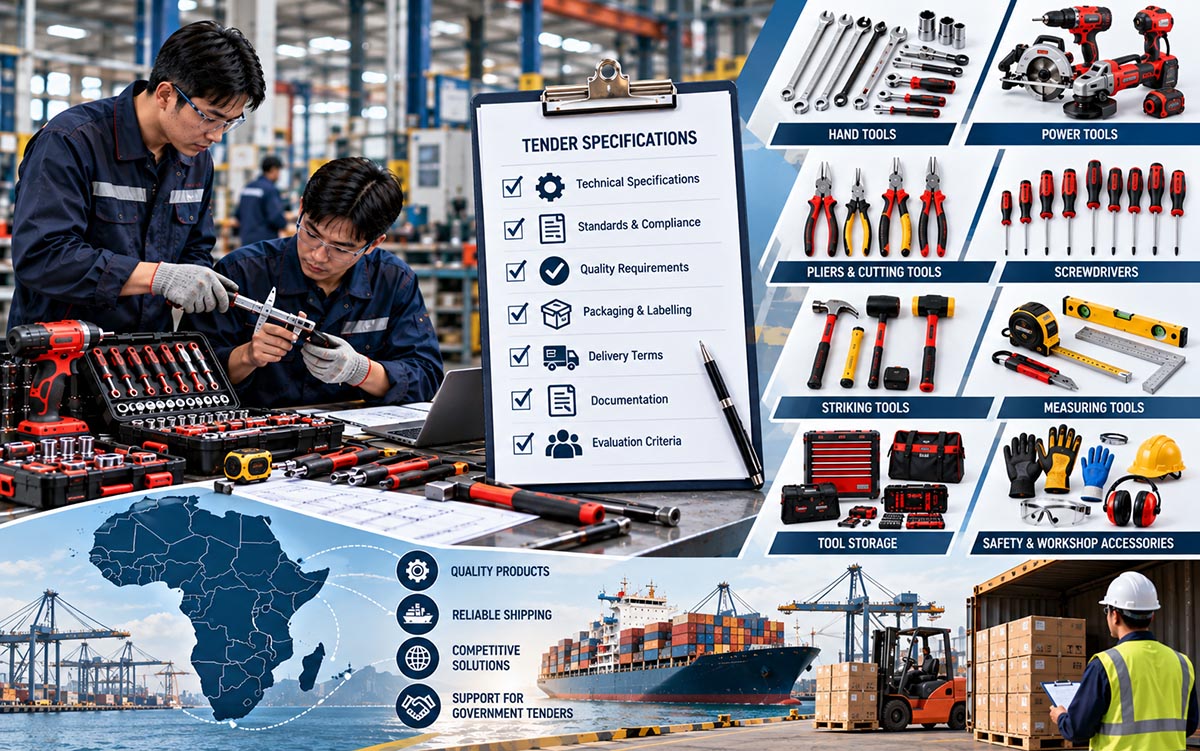
A tender specification is not a shopping list. It is the checklist an evaluation committee scores your bid against, and every line in it is a place where a bid can be marked non-responsive. This guide walks through the six tool categories that appear most often in African public tenders and sets out what the specification usually demands for each.
If you are writing a specification, this is what to put in it. If you are bidding, this is what to evidence.
1. Hand tools
The largest category by line count, and the one where “or equivalent” disputes are most frequent. Spanners, sockets, pliers, screwdrivers, hammers and chisels.
A well-drafted specification states:
- Material. Chrome vanadium for spanners and sockets, carbon steel for striking tools. Naming the grade — for example 40CrV or S2 for screwdriver bits — removes ambiguity.
- Hardness. Expressed in HRC with a range, not a single figure. Too hard and a tool becomes brittle; too soft and jaws round off.
- Finish. Chrome plated, phosphated or black oxide. Chrome is standard for spanners and sockets.
- Standard. DIN, ANSI or ISO reference for dimensions and torque performance.
- Marking. Size and material stamped or laser-marked on the tool body, not printed on a sticker.
- Metric or imperial. State which. A mixed-unit requirement should list both explicitly.
The commonest drafting mistake is specifying a brand and a part number without a functional description. That makes equivalence impossible to evaluate objectively and invites protest. Browse hand tools.
2. Workshop hand tools
Tool kits, tool boxes, trolleys and bench equipment — typically bought for vehicle workshops, depots and technical colleges, where the same kit is repeated dozens or hundreds of times.
Specifications for this category should cover:
- Kit content list. Every piece, with size. “150-piece tool kit” is meaningless on its own; two 150-piece kits can differ enormously in value.
- Case type. Blow-moulded plastic, steel box or trolley. State whether the case must hold each tool in a formed location, which matters for training environments where missing tools must be visible.
- Trolley construction. Steel gauge, number of drawers, drawer slide type and rating, castor size and lockability.
- Load rating per drawer and per shelf.
- Finish. Powder coat thickness, for humid or coastal storage.
For TVET tenders, add a requirement that every kit be identical and individually packed. Mixed contents across a delivery of identical kits is a frequent source of contract dispute. Browse workshop hand tools.
3. Power tools
Drills, grinders, sanders and the consumables that go with them. This is the category where electrical safety requirements bite, and where a specification most often omits something essential.
A complete power tool specification includes:
- Voltage and frequency. Most of these markets are 220–240V / 50Hz, but confirm rather than assume, and state it in the document.
- Plug type. Type G, C, D, E or M depending on the country. Supplying the wrong plug makes an otherwise compliant delivery unusable.
- Input power and no-load speed.
- Insulation class and, where required, residual current protection.
- Safety certification. CE or equivalent, plus any national electrical approval the destination requires.
- Duty cycle. Industrial or domestic. A domestic-grade grinder in a municipal workshop fails within months, and the specification, not the supplier, is usually to blame.
Specify the consumables separately with their own quantities. Discs and bits are consumed far faster than the tools, and a tender that supplies machines without a matching consumable schedule leaves the buyer stranded. Browse power tools.
4. Welding machines and tools
Welding equipment appears in road maintenance, railway, fabrication and technical training tenders. The specification needs both the machine and everything around it.
- Process. MMA, MIG or TIG, or a multi-process requirement.
- Output range in amps, and duty cycle at a stated output — for example 60% at 160A. Duty cycle quoted without the corresponding current is not a specification.
- Input supply. Single or three phase, voltage, and tolerance for unstable mains — important where generator supply is common.
- Accessories. Electrode holder, earth clamp, cable lengths and cross-section, gas regulator where relevant.
- Personal protective equipment. Helmets with a stated shade number, gloves, aprons. Frequently omitted, then added by variation at a higher price.
- Consumables. Electrode or wire type and diameter, with quantity.
Add a clause requiring operator training or at minimum a manual in the working language of the site. Browse welding machines and tools.
5. Power cutters
Cut-off saws, chain saws, brush cutters and the abrasive and diamond consumables they use. Common in road agencies, municipal works, fire services and forestry departments.
- Engine displacement in cc and power output in kW, or motor rating for electric units.
- Blade or bar size, and arbor diameter for cutters.
- Maximum cutting depth.
- Fuel type and mix ratio for two-stroke units, since this drives what the operator must be supplied with.
- Vibration and noise figures where occupational health rules apply.
- Consumable schedule. Abrasive cut-off wheels and diamond blades have a defined life. A tender for ten cutters and no blades is not a usable delivery.
For diamond blades, specify the material to be cut — concrete, asphalt, reinforced concrete or stone. Segment specification differs for each, and a general-purpose blade underperforms on all of them. Browse power cutters.
6. Agriculture tools
Hoes, machetes, axes, shovels, rakes, pruning tools and sprayers, usually bought by ministries of agriculture or development programmes in very high volumes for distribution to farmers.
- Blade material and thickness, and hardness at the cutting edge.
- Head weight. Regional preference varies considerably and a tool of the wrong weight is simply not used.
- Handle. Wood species or fibreglass, length, and how the head is fixed — eye fitting, socket or riveted tang.
- Local pattern. Hoe and machete shapes differ by country and by crop. A specification should include a drawing or a reference sample, not just a name.
- Marking. Distribution programmes frequently require a programme name or ministry mark stamped on the tool to discourage resale.
- Packing. Quantity per bundle or carton, for onward distribution to district level.
This is the category where a physical sample matters most. Where a tender allows it, approve a reference sample before production starts. Browse agriculture tools.
Writing a specification that can actually be evaluated
Three rules make a tool specification defensible:
- Describe function and measurable properties, not brands. If a brand must be named, add “or equivalent” and state what evidence of equivalence will be accepted.
- Give every parameter a tolerance. A single figure with no range invites a technical challenge from any bidder you reject.
- Specify packing and marking. Delivery disputes are more often about packing than about the tools inside it.
We supply against tender specifications from our own plants in China, with technical data sheets and a line-by-line comparison table for the evaluation committee. Send us the schedule and we will price it.
Need these tools in container quantities?
We manufacture in China and supply bulk orders and tender contracts. Send a product list or a tender schedule and we price it line by line.
Request a quote